Chuck Davis, b. 1954.
Independent curator and photographer based in the Ozarks. A practice in large format film, 3D stereo, and wet plate collodion — kept by hand.
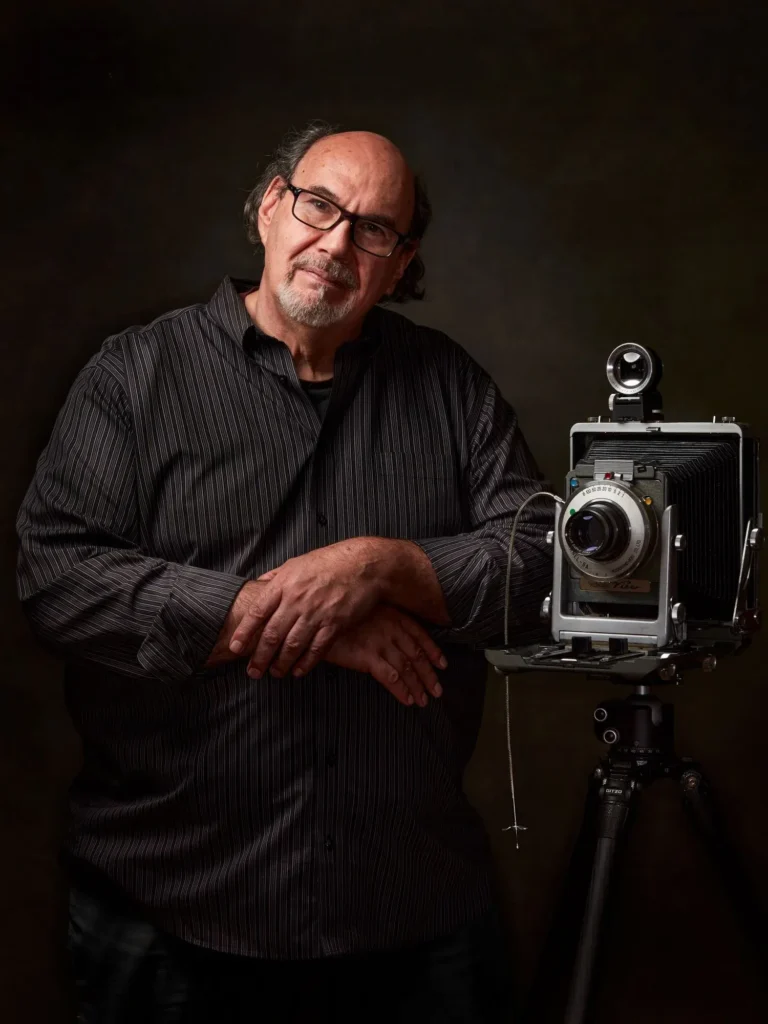
Working in the Ozarks, Chuck Davis (he/him/his) is an independent curator and photographer — a visual artist whose work critically observes Ozark history and the adjacent lands once described as Indian Territory. Of Indigenous and European descent, Chuck’s message traverses inter-generational tensions of both new and Native residents.
Chuck Davis (b. 1954) earned a BAFA in History of Photography from the University of New Mexico, and an MFA in Visual Arts from Lesley Art + Design in Cambridge, Massachusetts. He studied Photojournalism at the University of Missouri, earning a B.A. with Honors. After completing a residency at Casa Ranzini in São Paulo, Brazil in 2019, he was awarded an Arkansas Arts Humanity Grant in 2022 and an Art + Everywhere Grant in 2024.
He received a stipend award in 2021 and his work entered the permanent collection of the Regional Art Museum (RAM) in Fort Smith, Arkansas. In 2025 he exhibited at MASS MoCA while on retreat, and was in residency at Gallery RAG in Gloucester, Massachusetts. His next solo exhibit is at Mount Sequoyah, Fayetteville AR, during November and December 2025. He has just been awarded an Arkansas Individual Fellowship grant for Community Arts Engagement.
BA — Photojournalism, University of Missouri, Columbia
1975
BAFA — History of Photography, University of New Mexico, Albuquerque
1982
MFA — Art Institute of Boston / Lesley Art + Design
2019
Casa Ranzini — São Paulo, Brazil
2019
Al Capp's Home — Cambridge, MA
2018 & 2019
MASS MoCA — North Adams, MA · Art + Everywhere Retreat
2025
Gallery RAG — Gloucester, MA
2025
-
Artist Residency
-
Casa Ranzini, Sao Paulo, Brazil
-
(February 2019)
-
Artist Residency
-
Gallery RAG, Gloucester, MA
-
(July 2025)
-
Individual Artist Fellowship — Community Art Engagement
-
Arkansas Arts Council
-
Awarded October 2025
-
Dairy Hollow (Writers Residency)
-
Eureka Springs, AR
-
(January 2026)
-
Artist Fellow and Resident
-
Lesley Art+Design, Cambridge, MA.
-
(January 2026)
-
Stipend
-
Regional Arts Museum Fort Smith
-
2021
-
Grant
-
Arkansas Heritage Foundation
-
2022
-
Grant
-
Art + Everywhere Innovation Grant
-
2024
-
Grant
-
Art + Everywhere Development Grant
-
2025
-
Book
-
Chat Heap - Handmade Book (letterpress and handmade paper) 100 Copies
-
(2025)
-
Zine
-
Ozark Giraffe (80 copies)
-
(2025)
-
Magazine
-
Oxford American - Eyes on the South
-
(2025)
-
Magazine
-
The Idle Class Magazine - Stretch Your Neck Giraffe
-
(2025)
-
Magazine
-
Fabricated Realities – (Collaboration with Lisa Nance) Analogue Forever Magazine
-
March (2024)
-
Magazine
-
The Hand Magazine - Issue 17
-
(2017)
-
Magazine
-
The Hand Magazine - Issue 38
-
(2022)
-
Zine
-
PROCESS - ‘The Nexus of Northwest Arkansas’
Cambridge MA -
(January 2019)
-
Exhibit Catalog
-
Our Nature State - The Medium / Art Center of Ozarks
– Kudzu Press -
(2018)
-
Radio
-
Interview by KUAF National Public Radio
-
January 18, 2022
-
Print
-
Interview by Democrat Gazette, Fayetteville AR
-
February 20, 2022
-
Blog
-
Interview by The Arkansas Art Blog
-
February 24, 2025
2017 — 2026.
-
Chat Heap
-
Solo fence-wall activation at Ozark Beer Company, downtown Rogers, Arkansas
-
(Current)
-
Time Slips Through Your Fingers
-
Pinhole Fest 2026 - Pavlovka Art Gallery, Kiev, Ukraine
-
Curator Юлия Геннадиевна
-
Remember When
-
Wallkill Arts Center, Montgomery NY
-
Juror: Ransome (June - August 2026)
-
The Curated Fridge - Behind VA Shadows
-
Harvard Square, Cambridge MA
-
(January-March 2026)
-
Midwest Salon Trois - Midwest Nice Art
-
Aberdeen, South Dakota
-
Curators: Epiphany Knedler and Tim Rickett (January-March 2026)
-
Small Works On Paper
-
AR Heritage / Arkansas Arts Council — travel exhibition
-
AR Heritage / Arkansas Arts Council — travel exhibition
-
Roots / Wings
-
MASS MoCA, North Adams MA
-
Curator: Naima White
-
Living Image 2024 / 2025
-
Halide Project, Philadelphia
-
Juror: Adam Finkelston
-
Love Wins
-
Fenix Arts, Fayetteville AR
-
Curator: Laurie Foster
-
Exploring the Inevitable — The Art of Dying
-
Fenix Arts, Fayetteville AR
-
Curator: Laurie Foster
-
10th Anniversary Show
-
Local Color Gallery, Fayetteville AR
-
Trace Light
-
Gallery RAG, Gloucester MA
-
Curator: Tracy Hayes · with Rocky Neck residency
-
3D Gallery Artist
-
3D-Con, National Stereoscopic Association, MN
-
Contemporary Daguerrotypes
-
Daguerreian Society Symposium, Hartford CT
-
Individual Artist Fellowship — Community Art Engagement
-
Arkansas Arts Council
-
Awarded October 2025
-
Our Art, Our Region, Our Time (4th Annual)
-
Alexander Gallery / Porter Art Warehouse, Fayetteville AR
-
Beshore Gallery, Spiva Center for the Arts, Joplin MO
-
Curator: Adam Finkelston · also published in The Hand, Issue 50
-
Ozark Giraffes at Mt. Sequoyah
-
Mt. Sequoyah Hall Gallery, Fayetteville AR
-
Solo exhibition
-
Innovation Grant — Ozark Giraffe
-
Art + Everywhere
-
Distant Dialogues
-
Distant Dialogues
-
Float Magazine
-
Honorable Mention
-
Your Daily Photograph — Keetoowah Elder
-
Photogravure (Artist Proof)
-
9th Anniversary Show
-
Local Color Gallery, Fayetteville AR
-
Cambridge Art National Show
-
Cambridge MA
-
Juror: Ben Sloat
-
Healing Waters & Segregated Springs
-
3D-Con 2024, Wichita KS — presenter
-
Word Play
-
Fenix Arts, Fayetteville AR
-
Curator: Susan Idlet
-
Nexus of Northwest Arkansas
-
Fayetteville Public Library
-
Curator: Susan Idlet
-
Ozark Giraffe — Beyond a Home's Walls
-
Two-person fence wall exhibit with Mario Quiroz
-
Surreality
-
Fenix Arts, Fayetteville AR
-
Curator: Zeek Taylor
-
Current Works 2024
-
Leedy Volkus Gallery, Kansas City MO
-
Juror: Adam Finkelston
-
Art + Everywhere
-
VanDernoot Gallery, Cambridge MA — Lesley A+D 20th Anniversary
-
Magnificent Monochromes
-
Sage Gallery, Sheridan WY
-
Curator: Keith Davis
-
Les Femmes Fâchées: Angry Women
-
Fenix Arts, Fayetteville AR
-
Curator: Laurie Foster
-
Current Works 2023
-
Albrecht-Kemper Museum, St Joseph MO
-
Juror: Elijah Gowin
-
The Avoidance of Othering — Ozark Giraffes
-
Ozarks Symposium, Missouri State University–West Plains
-
Around Town
-
Local Color Gallery, Fayetteville AR
-
Curator: Alex Cogbill
-
Paper Routes
-
Fenix Arts — collaboration with Simone Wicca (Brazil)
-
The Wheel
-
Martha Jones Gallery, Fort Smith Regional Art Museum (RAM)
-
Solo · Stipend Grant + Lecture Series
-
PhotoSpiva
-
Spiva Arts Center, Joplin MO
-
Jurors: Eric & Erin Dodson
-
A Sense of Place
-
Fenix Arts, Fayetteville AR
-
Curator: Laurie Foster
-
Light Sensitive
-
Art Intersection, Gilbert AZ
-
Juror: Elizabeth Opalenik
-
Our Art, Our Region, Our Time (2nd Annual)
-
Walton Arts Center, Fayetteville AR
-
Exploring Mindscapes
-
Fort Smith Regional Art Museum (RAM)
-
Stipend & Solo Show Award
-
Re-Emergent
-
Mount Sequoyah / Fenix Arts, Fayetteville AR
-
Curator: Laurie Foster
-
Our Art, Our Region, Our Time (1st Annual)
-
Walton Arts Center, Fayetteville AR
-
Fresh From the Studio
-
Fenix Arts, Fayetteville AR
-
Curator: Laurie Foster
-
Día De Los Muertos
-
Mount Sequoyah Creative Spaces, Fayetteville AR
-
Curator: Lourdes Valverde
-
Control
-
Fenix Arts, Fayetteville AR
-
Curator: Ciara Froning
-
Chaos and Confusion
-
Fenix Arts, Fayetteville AR
-
PhotoSpiva
-
Spiva Arts Center, Joplin MO
-
Juror: April Watson
-
Rewilding the Grid
-
Raizes Gallery, Cambridge MA
-
Collaborations and Conversations
-
PROCESS Zine — The Nexus of Northwest Arkansas
-
Cambridge MA — published
-
Collaborations and Conversations
-
Fenix Arts, Fayetteville AR
-
PhotoSpiva
-
Spiva Arts Center, Joplin MO
-
Juror's Stipend Award · Patty Carroll
-
Flagship Heritage Biennial
-
VanDernoot Gallery, Cambridge MA
-
One Year Down
-
New Deal Studios, Little Rock AR
-
Curator: Rachel Trusty
-
Fenix at Nadine Baum
-
Walton Arts Center, Fayetteville AR
-
Delta des Refusés
-
Butler Center, Little Rock AR
-
Listed Artist
-
Arkansas Arts Council
-
Light Sensitive
-
Art Intersection, Gilbert AZ
-
Juror: Ann M. Jastrab
-
The Hand — Halloween 1981
-
Issue 17, July 2017 — published
-
Current Works 2017
-
Mallin & Charno Galleries, Kansas City MO
-
Juror: Keith Davis
-
In Our Natural State
-
Rogers Experimental House, Rogers AR
-
Two-person show with Dan Snow
-
2018
-
Our Natural State
-
Art Center of the Ozarks, Springdale AR
-
Works by 18 national & international artists — including Alec Soth, Mike Disfarmer, Tim Hursley, Sabine Schmidt.
-
2019
-
Camouflage & Calamity
-
Conway, Arkansas
-
Patty Carroll at Hendrix College
-
2022
-
The Hand at Fenix Arts
-
Mount Sequoyah, Fayetteville AR
-
Juried with The Hand Magazine.
The studio is
open
to inquiries.
For prints, exhibitions, or curatorial conversations — write a short note. Replies arrive in a day or two, sometimes longer during a darkroom week.